- Museum 10am-8pm
- Shop 10am-6pm
- Mon-Wed 11am-8pm - Thurs 11am-9pm - Fri-Sat 10am-9pm - Sun 10am-8pm
Name: J(ohn). R(ay). Cash, later Johnny Cash
Born: 26 February 1932
Parents: Ray Cash and Carrie Cloveree Rivers
Siblings: Roy, Margaret Louise, Jack, Reba, Joanne and Tommy
Wife: Vivian Liberto (1954-66) and June Carter (1968-2003)
Children: Kathy, Rosanne, Tara, Cindy with Vivian Liberto and John Carter Cash with June Carter
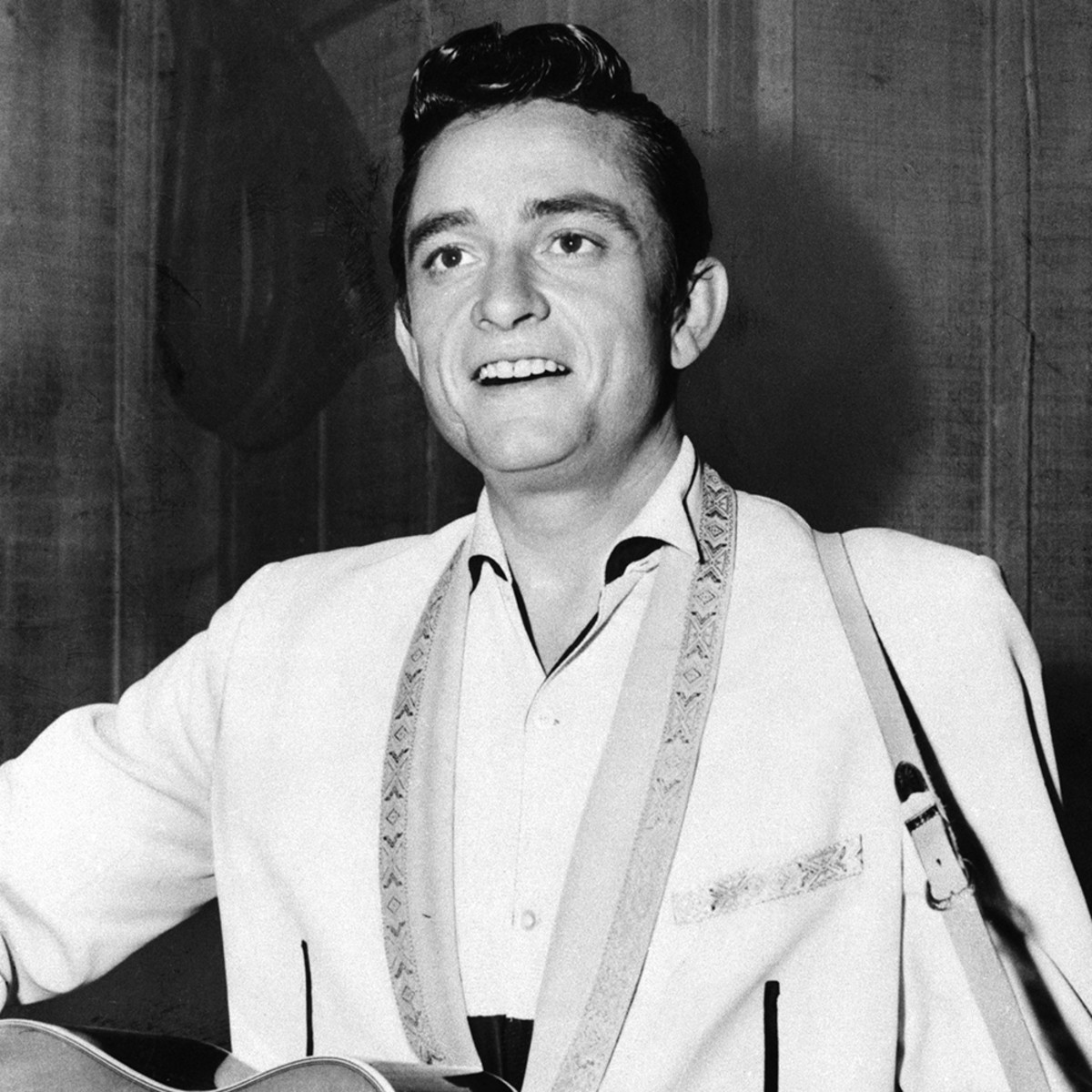
Johnny Cash was born on February 26, 1932 in Kingsland Arkansas, but moved with his family to Dyess, Arkansas at an early age. It is during the Great Depression, and the family has been given a house in an uncultivated area as part of Franklin D. Roosevelt’s “New Deal”. The family was poor, and they lived by harvesting cotton, where Cash was early involved in the fields. It was here that Cash first discovered his love of singing, which he learned from his mother, and eagerly used in the field, singing hymns and gospel music. Cash also eagerly listened to the music from the family’s one radio, and early on began to dream of singing.
Johnny Cash was born on February 26, 1932 in Kingsland Arkansas, but moved with his family to Dyess, Arkansas at an early age. It is during the Great Depression, and the family has been given a house in an uncultivated area as part of Franklin D. Roosevelt’s “New Deal”. The family was poor, and they lived by harvesting cotton, where Cash was early involved in the fields. It was here that Cash first discovered his love of singing, which he learned from his mother, and eagerly used in the field, singing hymns and gospel music. Cash also eagerly listened to the music from the family’s one radio, and early on began to dream of singing.
The 12-year-old Cash and his family receive a huge shock in 1944 when his older brother, Jack, dies in a serious accident at a sawmill. Jack’s death would follow Cash throughout his life, both as an inspiration and as a soul care. Cash already encountered tragedy at an early age, and it gave him a greater depth and understanding of the more painful aspects of life. When Cash later entered high school, his musical dreams were fully awakened, and he earned money by writing poems for his peers’ school assignments, and also appeared on the radio sometimes singing. Cash graduated in 1950, and shortly thereafter joined the US Air Force.
After initial training in the United States, Cash was sent to Landsberg in Germany. Here he served as a Morse operator, intercepting signals sent from the Red Army in Eastern Europe. The work was tiring and demanding, so Johnny spent much of his time listening to music and writing letters to the young girl, Vivian Liberto, whom he had met 3 weeks before he was deployed. Cash was madly in love and had an extensive correspondence with Vivian, but also got his first musical experiences with a small band in Landsberg. It was also here that Cash bought his first guitar, and among other things got the inspiration for his legendary song, Folsom Prison Blues, which came after seeing a movie in the cinema about the same prison. When Johnny Cash came back to the United States in 1954, he was determined to marry Vivian and to train to be able to work on the radio.
After initial training in the United States, Cash was sent to Landsberg in Germany. Here he served as a Morse operator, intercepting signals sent from the Red Army in Eastern Europe. The work was tiring and demanding, so Johnny spent much of his time listening to music and writing letters to the young girl, Vivian Liberto, whom he had met 3 weeks before he was deployed. Cash was madly in love and had an extensive correspondence with Vivian, but also got his first musical experiences with a small band in Landsberg. It was also here that Cash bought his first guitar, and among other things got the inspiration for his legendary song, Folsom Prison Blues, which came after seeing a movie in the cinema about the same prison. When Johnny Cash came back to the United States in 1954, he was determined to marry Vivian and to train to be able to work on the radio.
Shortly after Cash comes back to the United States, he is married to Vivian, moved to Memphis and works as an appliance salesman. In his spare time, Cash plays with Luther Perkins and Marshall Grant, the original Tennessee Two. Here Cash also becomes acquainted with the local record company, SUN Studio, and after repeated attempts, Cash gets an audition with the owner, Sam Phillips. Phillips is skeptical at first, but is taken in by Cash, and ends up signing a contract with him. At SUN, Cash gets his first hits with “Hey Porter” and Cry! Cry! Cry!”, and later “Folsom Prison Blues” and “I Walk The Line” also become big hits – the career is launched!
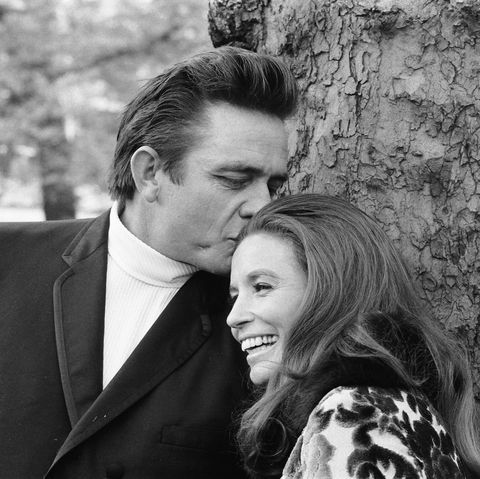
Johnny Cash hadn’t been at SUN long before he began to feel restricted. He therefore got a new contract with Columbia Records in 1958, where he would end up being for 28 years, until 1986. At Columbia, Johnny Cash was finally allowed to play his beloved gospel music, and his second album on the label was a gospel album . Along with his steady releases, Johnny Cash continued to tour, and it was here that he first got to perform with the Carter family and his future wife, June Carter. The two quickly become good friends, and eventually end up falling in love with each other. This results in the song “Ring of Fire”, written by June Carter about the then forbidden love of Johnny Cash.
Johnny Cash hadn’t been at SUN long before he began to feel restricted. He therefore got a new contract with Columbia Records in 1958, where he would end up being for 28 years, until 1986. At Columbia, Johnny Cash was finally allowed to play his beloved gospel music, and his second album on the label was a gospel album . Along with his steady releases, Johnny Cash continued to tour, and it was here that he first got to perform with the Carter family and his future wife, June Carter. The two quickly become good friends, and eventually end up falling in love with each other. This results in the song “Ring of Fire”, written by June Carter about the then forbidden love of Johnny Cash.
The many concerts and tours take a toll on everyone, and already in the 1950s, Cash starts taking amphetamine pills to keep himself going. In the 1960s, there is real abuse, and life becomes hard for Cash. He is arrested several times, where he spends the night in detention, and his marriage to Vivian ends in divorce in 1966. Johnny Cash’s period in the 60s gives him an image as a rebel, an outlaw. However, the abuse is too much, and after a sustained effort from June, family and friends, Cash gradually comes out of the addiction. However, the pills had to come back at regular intervals.
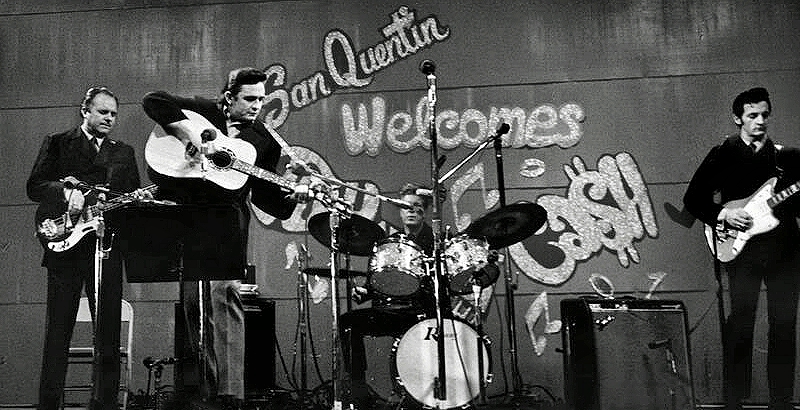
In 1968, Cash chooses to record two live concerts in Folsom Prison, which will be the start of his status as a superstar in American music. The album from Folsom is praised highly, and in the coming years Cash releases several acclaimed albums, and plays many large concerts in the USA and Europe. In 1970 he was invited to play at the White House, and in 1971 “Man in Black” was released, for which Cash has now begun to be known. Cash uses his status to advocate the cause of the helpless, against the war in Vietnam and for the rights of Indians. After coming off the pills, Cash also returns to his childhood faith, and Christianity begins to play a very large role in his life, among other things. in his friendship with Billy Graham.
In 1968, Cash chooses to record two live concerts in Folsom Prison, which will be the start of his status as a superstar in American music. The album from Folsom is praised highly, and in the coming years Cash releases several acclaimed albums, and plays many large concerts in the USA and Europe. In 1970 he was invited to play at the White House, and in 1971 “Man in Black” was released, for which Cash has now begun to be known. Cash uses his status to advocate the cause of the helpless, against the war in Vietnam and for the rights of Indians. After coming off the pills, Cash also returns to his childhood faith, and Christianity begins to play a very large role in his life, among other things. in his friendship with Billy Graham.
Alongside his music, Cash also starred in several films and series throughout his career. He played both a cowboy, an illiterate father, a gun-crazy criminal and John Brown in a series about the American Civil War. The biggest, however, was The Johnny Cash Show, where he hosted a musical show that featured a lot of musicians, big and small. Two of the prominent guests were e.g. Bob Dylan and Roy Orbison, but there were also other guests – e.g. Kris Kristofferson, the original writer of “Sunday Morning Coming Down”.
In the 80s, Cash played and performed with his friends and country stars, Willie Nelson, Waylon Jennings and Kris Kristofferson. The four toured as The Highwaymen, and were country music’s first supergroup. The 80s also meant an end to Cash’s collaboration with Columbia, who chose to release Cash as they believed he wasn’t making enough money. The 80s meant a decline in sales, both of records and of concerts, which partly explained Columbia’s choice. After Columbia, Cash joined Mercury Records, but that didn’t improve the situation much. It was at this low point in his career that Cash and Rick Rubin found each other.
In the 80s, Cash played and performed with his friends and country stars, Willie Nelson, Waylon Jennings and Kris Kristofferson. The four toured as The Highwaymen, and were country music’s first supergroup. The 80s also meant an end to Cash’s collaboration with Columbia, who chose to release Cash as they believed he wasn’t making enough money. The 80s meant a decline in sales, both of records and of concerts, which partly explained Columbia’s choice. After Columbia, Cash joined Mercury Records, but that didn’t improve the situation much. It was at this low point in his career that Cash and Rick Rubin found each other.
Rubin and Cash meet in the first half of the 90s, and enter into a collaboration to make music together, because Rubin sees huge potential in Cash. The music is a completely new style for Cash, with the first album, American Recordings (1994), consisting only of Cash and his guitar. The album becomes a huge success and gives Cash a musical and creative renaissance. The collaboration with Rubin bears great fruit, and in the following years Cash releases 3 more albums, Unchained (1996), American III: Solitary Man (2000) and American IV: The Man Comes Around (2002). The new albums show a whole new side of Cash and get a new young audience to listen to his music.
In the last years of his life, Cash suffers from complications from diabetes, but continues to sing, write and play music. In May 2003, June Carter dies after a heart operation, and Cash himself dies just over 4 months later, on September 12. Cash left behind a huge musical legacy, with over 1,000 songs written and 97 albums released. After his death, 3 more albums were released with American Recordings: Unearthed (2003), American V: A Hundred Highways (2006) and American VI: Ain’t No Grave (2010).
In the last years of his life, Cash suffers from complications from diabetes, but continues to sing, write and play music. In May 2003, June Carter dies after a heart operation, and Cash himself dies just over 4 months later, on September 12. Cash left behind a huge musical legacy, with over 1,000 songs written and 97 albums released. After his death, 3 more albums were released with American Recordings: Unearthed (2003), American V: A Hundred Highways (2006) and American VI: Ain’t No Grave (2010).
To provide the best experiences, we and our partners use technologies like cookies to store and/or access device information. Consenting to these technologies will allow us and our partners to process personal data such as browsing behavior or unique IDs on this site and show (non-) personalized ads. Not consenting or withdrawing consent, may adversely affect certain features and functions.
Click below to consent to the above or make granular choices. Your choices will be applied to this site only. You can change your settings at any time, including withdrawing your consent, by using the toggles on the Cookie Policy, or by clicking on the manage consent button at the bottom of the screen.